
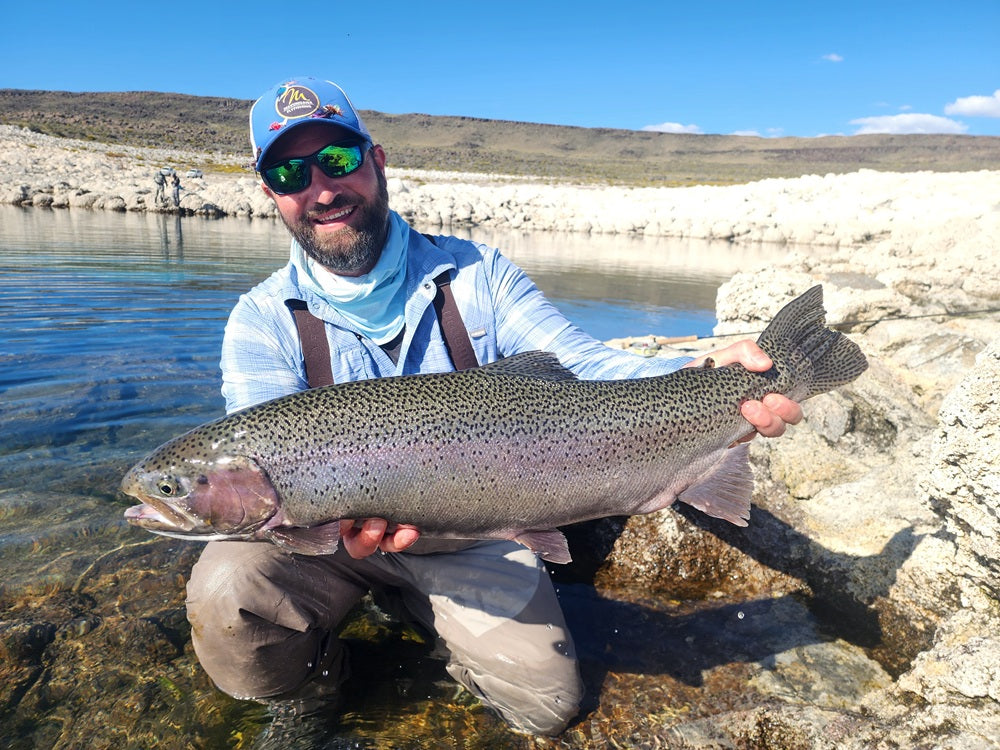

Anyone that knows me, knows that trout and I have never seen eye to eye. In the past, if they weren’t being gluttons and chasing down big streamers I would just give up, I was too dumb to get technical with flies and leaders which should come with a free magnifying glass. I had just returned from the frantic chaos of the Amazon, and with just a week and some change, I was headed back to Latin America to chase trout in Patagonia, Argentina, at Lagos Strobel. It was not exactly the drug I needed to maintain the high-octane addiction I have acquired from the likes of tarpon, tigerfish and peacock bass. I didn’t have sleepless nights playing tackle prep on loop in my head.
I have heard from wiser people that travel fishing is all about the experience, and being a guide myself, I strive to provide an experience to people spending time on the water, and off, with me. But deep down, the experience part never switched on for me personally, all that mattered was fishing. I look back now and have realised that I have spent years missing the point of it all completely. Argentina got rid of my “experience loadshedding”.
My rehabilitation began in Buenos Aires (BA). A city is a city to me, and I avoid them as much as I can. Not once during my few days in BA, did I ever get the feeling that I needed to be somewhere else (i.e. fishing). Roaming the Jacaranda lined streets felt like memories of Johannesburg many decades ago. The sense of safety, cleanliness and hum of Argentine Rock around each corner makes you wonder how Argentina is labelled third world, whereas some of our cities back home could seriously learn a thing or two from BA. There were enough pubs and steak houses to keep us entertained and we didn’t even scratch the surface of what most normal people would appreciate in this magnificent city. A few extra days spent exploring BA won’t go a miss!

From BA you fly way south into Patagonia, the destination being El Calafate. Humidity changes to biting cold and wind. When you look across the milky blue glacier fed Lagos Argentino (the largest lake in Argentina) you can immediately spot where frosty weather comes from. The snow-capped Andes Mountains stand guard to the west and extend as far as the eye can see. El Calafate is best described to South Africans as if Dullstroom and Clarens had a baby, which was then sent to boarding school overseas. The gateway to Los Glaciares National Park, the famous Perito Moreno Glacier and Southern Patagonian Icefield (the second biggest in the world), it is truly centred around tourists exploring Patagonia. I must admit, it was the first time in my life I asked for a photo of me against the background, real tourist like. Using El Calafate as a base one can explore Patagonia to your heart’s content and like BA, I needed more time there. After a night at Cerveza Patagonia we were finally on our way to Lagos Strobel.

Ahead lay around five hours on Route 40, a road which dissects Latin America from Patagonia all the way to Bolivia. The Steppe landscape, milkshake coloured glacier lakes, Andes range and meandering rivers keep the eyes constantly engaged. A pitstop at La Leóna, basically the Patagonian equivalent of a South African padstal, for coffee and empanadas highlights the history of this wild west. The man that basically described Patagonia, Francisco P. Moreno was mauled by a Puma in that postal code in 1877. Butch Cassidy and the Sundance Kid hid from the law on this property in the early 1900s. As you leave La Leóna you are greeted by Lago Viedma, another funky milkshake lake, but looking across the lake, you see Mount Fitzroy (the famous logo of Patagonia Apparel). From here on out one really starts to feel isolated, a familiar feeling to me but this was different. Out of nowhere the tarred road ends and is met by gravel, the infamous Los 73 Malditos (The Damned 73). At this disparity of road conditions, we were met by our guides for the week from Estancia Laguna Verde Lodge (ELV). Our comfortable sedan is now replaced by Toyota Hilux offroad chariots. A compulsory cerveza, some high fives and off we went for the last few hours of the drive.

It’s always a bit awkward meeting someone new, especially if their native tongue isn’t English, and knowing for the next few hours you will need to converse. Well ten minutes in and you would have sworn Martin (head guide at ELV) and I had spent years chasing fish together. We will touch on the topic later, but the guides at ELV are next level. I can’t even remember how long the drive was, but we spoke about our careers, fishing, family and how the Santa Cruz province only has a population of around 400 000 people but 2 million Guanacos (where Llamas come from). As we climbed ontop of the last Maseta (plateau) that feeling of isolation grew. Again, I’m used to remote areas but the fact that the surrounding 2500 km2 only has a population of 200 people (if all the lodges in the area are full) really emphasizes the starkness. After the last few bumps on the road, you are greeted by Estancia Laguna Verde Lodge. From the outside it may not look like much, but that simple exterior is made to be under snow in the winter months. Inside, the warm homely atmosphere makes you forget that we are in a place where you will die if you get lost in the wilderness. Even the Wader Room has a touch of class, and is almost a highlight in itself at the start of each day.

There was fishing literally a cast away right in front of us, Laguna Verde (which has rainbows, browns and brook trout). Yet life takes on a very “rustig” pace in Argentina and we decided to rather watch the Boks smash Ireland in a tense rugby international test match, than go out and smash fish, the experience part truly had a grip on us. After the Boks victory and more than a few celebratory cervezas, the guides took us to the Moro Creek for an hour or two before the end of the day. That quick session changed my mind completely on this place. The Moro is ankle deep and more like a swamp than a trout stream, if it wasn’t so cold I would have thought we were chasing bass or tilapia. Within seconds you see trout push up the current and if you skate a big mouse fly in front of them, the violent eats also don’t belong to trout. That was our first taste of ELV and the diversity it has to offer. We honestly could have started the journey back home after that session given how insane it was.

I had preconceived ideas of Lagos Strobel, better known as Jurassic Lake. The picture painted in my mind from youtube videos and conversations with people that had been there years ago at another completely different lodge, was that you fish a couple spots during the week and basically just put a fly in the water to catch a giant trout. Shooting fish in a barrel, rinse and repeat. Well, that painted picture I had turned out to be kitsch. Each day you would jump into your offroad chariot with no idea where you were going or what the guides had instore for you. The options are endless and you won’t be able to see it all in a week. ELV has exclusive access to over 30 km of shoreline around Lagos Strobel, more than 10 km of the Barrancoso River, countless Lagunas (small natural lakes) between 5 and 30 hectares in size and the Moro Creek. The diversity of fishable water is what sets ELV apart. With all these options, it allows you to have great fishing no matter the weather. A day can literally be spent chasing 20 lb “chromers” in Lagos Strobel in the morning, skating mice patterns on the Barrancoso River in the afternoon and then ending the day by going after brown and brook trout in a laguna.
The one thing that did ring true from everything I had heard of Lagos Strobel, was the wind. That part of the world is the testing grounds for wind, from there the wind gets shipped around the world. The guides are quick to tell you that you must make the wind your friend and not to fight it, because you will lose. Due to all the available options, the guides always put you where you can cast, even though you might be fishing off a point which is more akin to rock and surf fishing spots in the Transkei with waves crashing, than a placid trout lake. The thing is the trout in Patagonia also love the wind, they will feed a rod’s length away from the edge in the wash. Far casts can be detrimental to your success, it took me a while to realise that.

The styles of fishing also constantly changed and expanded my idea of trout fishing. The standard, if the wind is up, is drifting balanced leeches underneath indicators large enough to save a person from drowning in a rip current. When conditions were calmer dry dropper rigs were the way to go, although the nymphs are still tiny, the weapons grade hooks required to hold these fish made these standard nymphs tick all the right boxes in my ham-fisted head. My personal favourite was sailing battleship sized hoppers over the coral like reefs to sighted giants. To watch a trout, unlike any you have seen before, rise up through the water column to investigate your vessel floating out there truly gets the heart racing. Just don’t rush the strike! This trout fishing thing is very under-rated!

I could wax lyrically about the fishing, but it does all sum up to the fact that Lagos Strobel, and the surrounding waters, are the rainbow trout mecca of the world. The trout are massive, they fight hard and they reward you if you put in the effort. However, the true product here isn’t the fish. The lodge staff and guides truly blew us away. Argentinians are so similar to us South Africans - they love a braai (Asado), a good glass of wine or beer and have a sense of humour I have only ever seen back home. Where we have Brandy, they have Fernet. The similarities are a plenty! The guides are world class, and they even made me think of ways in which to step up my own guiding game. They are always engaging with you and they know their story, constantly changing your setup and the number of times the next cast goes tight is honestly uncanny. They will show you a good time no matter your capabilities, which is special for a fishery to be so accommodating.
You won’t lose weight either with the fantastic meals, which are always paired with some bottle of Malbec from some or other region of Argentina. Always accompanied by great conversation. Asado night, especially, goes into the early hours of the morning with karaoke and laughs. There is such a sense of family hospitability at ELV that I’m yet to see elsewhere.

A week of fishing always goes by fast. At the end of a trip to destinations like the Amazon, one is happy to head home because your body can’t take another session. At ELV however you wish you could stay longer, not for the fishing, but rather for the home and comradery that you had for the week.
If you'd want to experience this first hand, drop us a line travel@flyfishing.co.za to join our upcoming prime week at ELV.
Blog by Mike Dames
